
This blog focuses on the importance of rest and recovery for endurance runners
Whether you are new to running or you have thousands of miles under your belt, getting everything right in training is a real challenge. Developing a program which works for you, fits your lifestyle and includes all the aspects of training needed to improve can be tricky at the best of times. In previous blogs we’ve discussed a variety of things that could help you improve your performance, from core stability and threshold running to pre-race visualisation and the diet of Kenyan runners. However, one of the most important and most commonly misunderstood aspects of training is rest. In this two part blog series we will look into the science of rest and recovery and explore how the body adapts to training in order to bring about improvement.
In part one we will focus on the adaptation process which highlights just why the oft dreaded ‘rest day’ might just be one of the most important parts of your training program.
How does training make you run faster?
Runners are naturally driven people. Driven to get out the door to train even in the cold winter months; Driven to go the gym after work when the sofa and TV are much more appealing; Driven to do your best and ultimately to seek improvement. However, it is also this inner drive for constant improvement which I would argue is the downfall of a lot of athletes. Many runners are of the mind-set; ‘the harder I train, the more I will improve’. While to a certain extent this is true there will come a point where your body simply cannot handle the training load, and so taking the same phrase but switching the word ‘harder’ for ‘smarter’ is ultimately a much better way of looking at it: ‘the smarter I train, the more I will improve’. One thing that every runner can do to train smarter is include planned rest periods throughout their training.
When we train, we are stressing the body in some way. For example during a threshold run the following stresses are placed on your system:
- A larger and high frequency force is exerted through the muscles in the legs which requires a greater energy consumption.
- Heart rate and stroke volume increases which requires a greater force to be produced from the cardiac muscles and valves. This also results in an increase in blood pressure, placing stress on blood vessels.
- Breathing volume and rate both increase as the muscles demand for oxygen increases.
- Rate of lactic acid production increases and the muscles become more acidic.
That is far from an exhaustive list but highlights some of the basic stress stimuli the body experiences during hard training. These stresses result in damage being inflicted on the areas involved including the muscle fibres, lungs, cardiac muscles/valves etc.
The stress adaptation cycle
Fear not however, as the human body is nothing if not an expert in adaptation. This physical stress caused by your training begins a process of recover, repair and rebuilding of these damages. Not only do they repair to the same level as before but as a future protective mechanism they become even stronger and thus better adapted to the stresses placed on them. This is the basic principle by which physical improvement occurs. A constant cycle of stress & adaptation, further stress & further adaptation and so on. Most runners are aware of this cyclical process, yet many of us do not use this knowledge in an effective way and allow our own thought processes to be dominated by the stress and choose to the overlook or marginalise the adaptation.
The picture below shows a basic cycle of stress and adaptation in response to a training stimulus:
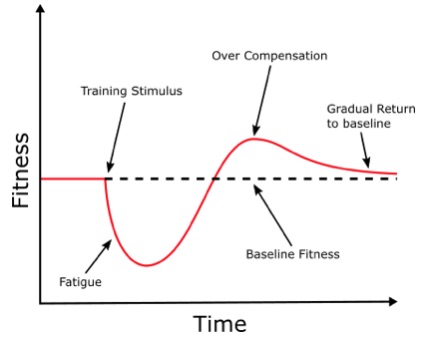
We can see that immediately after training the body experiences fatigue. Your immune system is depressed, energy reserves are depleted, muscle fibres have been damaged and more. Indeed you will likely feel this yourself in the form of exhaustion, you may find it hard to even walk to the shops or stay awake at work after a particularly tough workout. You will continue to experience the symptoms of fatigue as your body uses energy to repair the damaged tissues and replenish reserves. This is a costly process in terms of energy supply and which is why professional athletes will sit down or have a nap after their training sessions; allowing the body to focus its energy supply on recovery.
An increase in fitness
We can also see from the graph that the body recovers beyond the baseline fitness level, this is known as over or super compensation and it’s the body’s way of adapting to physiological stress. It recognises that a physical demand was placed on it which was higher than that it was currently capable of so grows back stronger in order to develop a buffer against that level of (di)stress in the future. (Little does it know of your evil plans to push it ever higher again in future training…)
The next image shows a period of idealistic training, in which the body experiences repeated training loads.
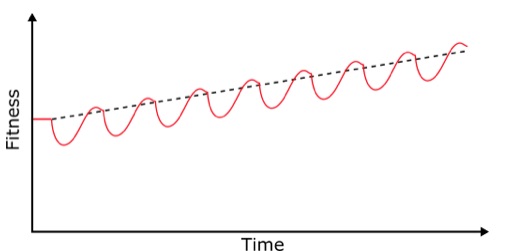
Here we can see that, providing we allow the body enough time to recover, fitness will increase as we adapt to training. This is of course a very simplified representation of what is going on; The type and intensity of your workout, your experience level and numerous other factors will influence both the time it takes to recover and the size of the over compensation.
The pitfall of neglecting adequate rest time
If however, we do not allow our bodies enough time to recover from training we see the opposite effect:
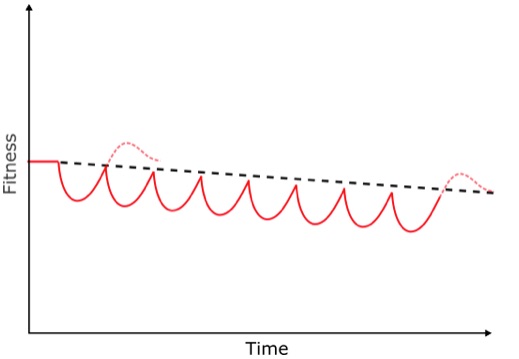
Without sufficient recovery time our bodies cannot return to baseline fitness or experience over compensation, which is the entire purpose of the hard training. In fact, the body will continue to deteriorate and fitness will decrease.
However, instead of recognising a need for more adaptation time, it is at this point that many a highly motivated runner will think the exact opposite and instead tell themselves “I’m not improving so I need to train more/harder”. Unfortunately, this is going to have the exact opposite of their desired outcome. This is what is known as over training and as well as a decrease in performance (and constantly building frustration), can eventually lead to injury or illness.
The next step
We now have a good grounding and understanding in the basics of how the body brings out improvement in fitness. You can see the vital role that rest and recovery plays in allowing an adaptation to occur, and the pitfalls which inevitably follow if this basic principle is not adhered too.
We know the difficulty that many runners face: The more motivated you are to improve, the harder it can be to follow the seemingly counter-intuitive idea of not training hard. Next time around we will look at the specifics of post training recovery, rest days, rest periods, and give you real life examples from elite runners in the training camps in Kenya.
Thanks for reading,
Callum
About the author

Callum Jones is an engineering master’s graduate of the University of Bristol and middle distance runner who has spent long periods of time training in Kenya. He began working for the Kenya Experience in October 2017.
“I’ve been an aspiring distance runner for the last 10 years and worked hard to improve my times year after year. Training in Iten was an incredible experience for me, it really took my running and love for the sport to a new level and opened my eyes to a whole new mentality towards training. Working for Kenya Experience is fantastic as I can offer my knowledge of the sport and insight into the Kenyan running culture with our guests.”
About Us
The Kenya Experience – Running Camps in Iten Kenya for all runners
Our running camps provide an inspirational location, expert coaching and a supportive group environment for runners of all levels.
With an emphasis on ‘doing it the Kenyan way’ the camps include guided runs, practical workshops and an exciting itinerary outside of the actual training itself which will immerse you inside the Kenyan running scene. You will meet and learn from top Kenyan runners & coaches and interact with the local community in Iten under the guidance of our expert staff.
Want to know more? Click here for details on our training camps
Recent Comments